SodaSlim Official Website › Blog › Caffeine
How Much Caffeine Is In A Capsule That Does Not Say?
A capsule that names caffeine and prints no amount cannot be counted against a daily ceiling. Health Canada's review puts that ceiling at 400 mg a day for healthy adults, and two coffees can use most of it. The practical answer is to assume a strong coffee's worth, subtract one drink from the day, and spend the first week finding out what the capsule does to you.
Why this row is different from the other four
A supplement label that withholds its amounts is withholding a value judgement. You cannot tell whether the green tea extract is at a useful strength, whether the garcinia reaches the amount that failed in a trial, or whether the green coffee reaches the amount that worked in one. Those are all questions about whether you are getting your money's worth.
Caffeine is not like that. It is the one ingredient on a label of this kind where the number is a safety number, because there is a published daily ceiling for healthy adults and most people are already somewhere against it before breakfast is over.
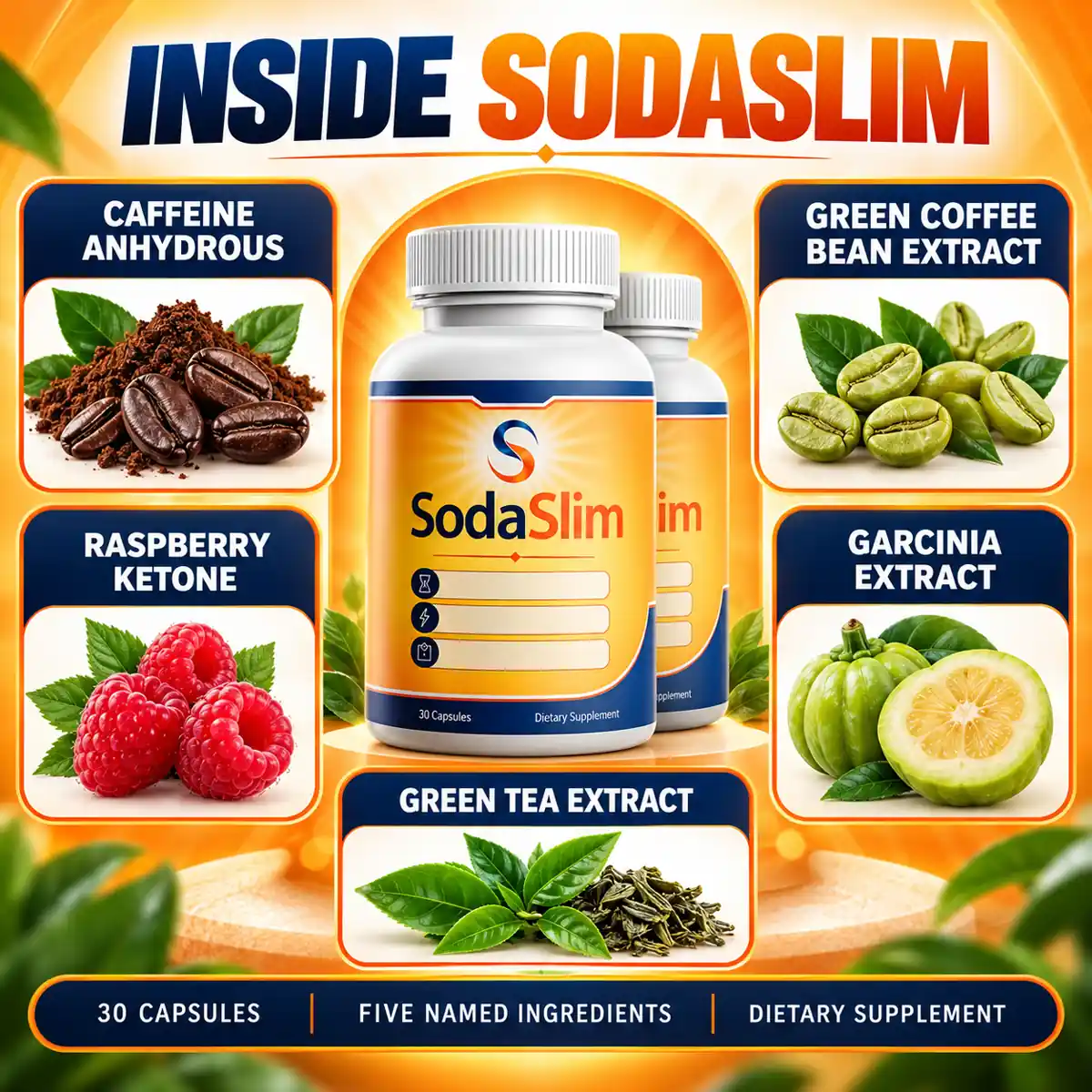
SodaSlim names caffeine anhydrous first on the front of the bottle and prints no figure for it. This post is about what a careful person does with that.
The 400 mg figure, and where it comes from
The number most often quoted comes from a Health Canada review published in Food Additives and Contaminants in 2003, which assessed the human evidence and concluded that moderate daily caffeine intake up to 400 mg is not associated with adverse effects in healthy adults. The review expresses it as about 6 mg per kilogram of body weight, which is 390 mg for a 65 kg person.
Above that it associates caffeine with effects on the cardiovascular system, on bone status, on behaviour, and on the developing fetus, with lower thresholds given for women who may become pregnant.
Two things about that figure are worth keeping straight. It is a general-population figure rather than a personal one, and individual sensitivity varies a great deal. And it is a daily total, not a per-dose limit: the arithmetic that matters is everything across a day, added up.
What a day already contains before the capsule
This is the part people underestimate, and it is easy to check against your own morning.
| What you drink | Typical caffeine | Running total |
|---|---|---|
| One mug of filter coffee | 95–165 mg | 95–165 mg |
| A second mug | 95–165 mg | 190–330 mg |
| A mug of black tea in the afternoon | 40–70 mg | 230–400 mg |
| A can of cola with lunch | 30–45 mg | 260–445 mg |
| A capsule naming caffeine anhydrous | Unstated | Unknown |
Drink figures are typical published ranges rather than measurements of any particular brand. The point of the table is the last row.
Two coffees and an afternoon tea already takes a moderate drinker to somewhere between half and the whole of the reviewed daily allowance. Add a capsule with no number on it and the day's total is genuinely unknown, which is a different situation from being over the limit and a worse one to be in: you cannot correct what you cannot measure.
It is also worth noticing that several of the other ingredients on a label like this one carry caffeine of their own. Green tea extract does. Green coffee bean extract does unless it has been decaffeinated, and the label does not say which it is.
How to measure an unknown in one week
You cannot find the number. You can find out what the capsule does to you, which is the practically useful version of the same question, and it takes about seven days.
- Day one. Take the capsule in the morning and drink nothing else caffeinated until the afternoon. Note how you feel at one hour, three hours and at bedtime.
- Days two to four. Add your usual first coffee back. Note the same three moments. The difference between day one and day three is the size of your everyday caffeine habit, not the capsule.
- Days five to seven. Go back to what you normally drink, minus one cup. That cup is the room you are making for the capsule.
- At any point, if you are jittery, sleeping badly or noticing your heartbeat at rest, take the other caffeine down before you take the capsule away. It is the variable you can actually control.
- If it is still uncomfortable at one capsule with nothing else caffeinated, the formula is not for you, and a sixty-day money-back window exists for precisely this.
Treat one capsule as though it carried a strong coffee's worth of caffeine and subtract a drink from the day to make room. That is probably generous, and being generous with a stimulant estimate is the error worth making.
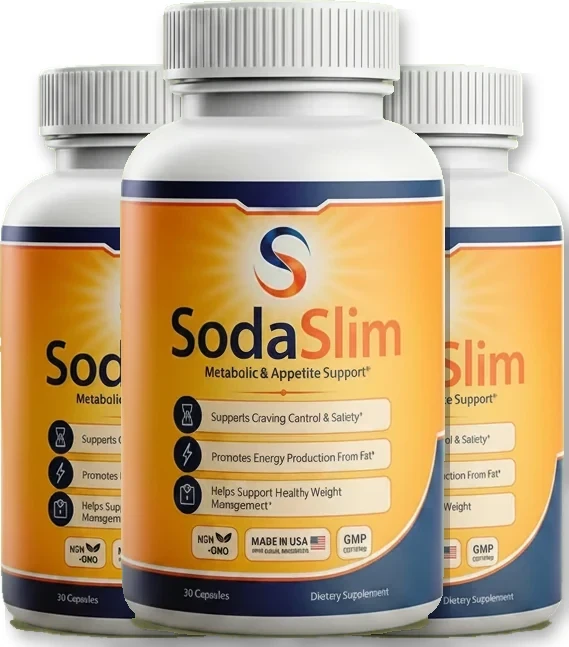
SodaSlim is one capsule a morning, and the first week is the test
Five named ingredients, a sixty-day window counted from purchase, and an ingredients page that prints the amount every trial used.
$158 for two bottles, $294 for six, and 60 days from the date you buy
Order SodaSlim On The Official WebsiteLot SOD-26/SO-5737 · 30 capsules · taken once each morning
How much difference caffeine actually makes
Worth putting beside the safety question, because the effect is real and small and both halves of that matter.
In a 1989 room-respirometer study, a single 100 mg dose raised resting metabolic rate by three to four per cent over 150 minutes in both lean and post-obese volunteers. Repeating 100 mg every two hours across a twelve-hour day raised daytime energy expenditure by eight to eleven per cent, and the following twelve-hour night was unchanged. The net came to 150 extra kilocalories a day in the lean group and 79 in the post-obese one.
Pooling the later work, a 2019 dose-response meta-analysis of thirteen randomised trials in 606 people found that each doubling of caffeine intake was associated with about 22 per cent more weight reduction, with very high heterogeneity between studies. And a respiration-chamber meta-analysis put the slope at roughly 0.4 to 0.5 kilojoules of extra daily energy expenditure per milligram, while finding that 24-hour fat oxidation rose only when catechins were present alongside the caffeine.
So the honest summary is that a meaningful caffeine dose buys something on the order of a slice of bread a day, and that it is entirely erasable by eating one.
What goes wrong, and how quickly
The ordinary problems arrive in the first few days and almost all of them are fixable without stopping.
- Jitteriness. Take the capsule with food and remove one coffee from the same morning.
- A noticeable heartbeat. Caffeine raises heart rate and blood pressure acutely. A mild brief version is ordinary; awareness of your own heartbeat at rest is a reason to stop and speak to a doctor.
- Disturbed sleep. Nearly always timing. A capsule taken after lunch has a meaningful fraction of its caffeine still circulating at bedtime.
- Stomach discomfort. Usually an empty stomach. Move it to the first food of the day.
- A headache on stopping. Caffeine withdrawal, not a sign the capsule was doing something. Taper the drinks for two days rather than treating it as a symptom.
For scale on the rare end of the distribution, the CDC's emergency-department surveillance study estimated 23,005 US emergency visits a year attributable to dietary supplements, with weight-loss products the largest single category among single-supplement cases and adults aged 20 to 34 the commonest patients. That is a very small fraction of an enormous number of doses, and it is not zero.
What a label could print instead
It is easy to complain about a missing figure and harder to say what good looks like, so here is the short version.
| What a good label prints | Why it helps |
|---|---|
| Caffeine, with a milligram figure | The one row a reader can act on immediately |
| A total caffeine line covering every source in the formula | Green tea and green coffee both contribute; a single caffeine row can understate the total |
| Whether an extract is decaffeinated | Decaffeinated green coffee is a different ingredient from the caffeinated kind |
| An extract percentage as well as a weight | 500 mg of extract at 5 per cent is 25 mg of the studied compound |
| A specific caution rather than a general one | “Contains caffeine, not for those sensitive to stimulants” excludes someone; “consult your physician” excludes nobody |
None of this is unusual. Plenty of labels in this category print all five.
The sentence to give a prescriber
If you take any prescription medicine, the useful thing to bring to the conversation is not the ingredient list.
It is this: “this capsule contains caffeine and the label does not say how much.” That sentence contains the part a clinician cannot look up, and it is the part their answer depends on. Handing over a five-name list invites them to check five ingredients against a database and conclude, reasonably, that nothing obvious interacts, which misses the actual issue.
Bring the bottle if you can. The NIH Office of Dietary Supplements makes the same point about supplements generally: the label is the document, and bringing it to an appointment is worth more than describing it.
The verdict
A metabolism capsule that names caffeine anhydrous first and prints no figure is asking for a specific kind of trust, and the honest response is a specific kind of caution rather than a refusal.
Take it in the morning, take it with food if it sits badly, subtract one caffeinated drink from the day to make room, and use the first week to find out what it does to you rather than what it does for you. If the answer is uncomfortable at a single capsule with nothing else in the morning, stop; the guarantee exists for that and the product is not for you.
And if the bottle you receive turns out to carry a Supplement Facts panel on the reverse, read the figure there and use it. The bottle is the document with authority. This desk would genuinely like to see a photograph of one.
Sources
- Nawrot P, Jordan S, Eastwood J, Rotstein J, Hugenholtz A, Feeley M. Effects of caffeine on human health. Food Addit Contam. 2003;20(1):1-30. PMID 12519715. https://pubmed.ncbi.nlm.nih.gov/12519715/
- Dulloo AG, Geissler CA, Horton T, Collins A, Miller DS. Normal caffeine consumption: influence on thermogenesis and daily energy expenditure in lean and postobese human volunteers. Am J Clin Nutr. 1989;49(1):44-50. PMID 2912010. https://pubmed.ncbi.nlm.nih.gov/2912010/
- Tabrizi R, Saneei P, Lankarani KB, et al. The effects of caffeine intake on weight loss: a systematic review and dose-response meta-analysis of randomized controlled trials. Crit Rev Food Sci Nutr. 2019;59(16):2688-2696. PMID 30335479. https://pubmed.ncbi.nlm.nih.gov/30335479/
- Hursel R, Viechtbauer W, Dulloo AG, et al. The effects of catechin rich teas and caffeine on energy expenditure and fat oxidation: a meta-analysis. Obes Rev. 2011;12(7):e573-81. PMID 21366839. https://pubmed.ncbi.nlm.nih.gov/21366839/
- Maufrais C, Sarafian D, Dulloo A, Montani JP. Cardiovascular and metabolic responses to the ingestion of caffeinated herbal tea: drink it hot or cold? Front Physiol. 2018;9:315. PMID 29681860. https://pubmed.ncbi.nlm.nih.gov/29681860/
- Geller AI, Shehab N, Weidle NJ, et al. Emergency department visits for adverse events related to dietary supplements. N Engl J Med. 2015;373(16):1531-40. PMID 26465986. https://pubmed.ncbi.nlm.nih.gov/26465986/
- Dietary Supplements for Weight Loss: Fact Sheet for Consumers. Office of Dietary Supplements, National Institutes of Health. https://ods.od.nih.gov/factsheets/WeightLoss-Consumer/