SodaSlim Official Website › Blog › Green coffee
Green Coffee Bean Extract And The Trial That Was Retracted
The trial that built the green coffee category was retracted in 2014. It tested 700 mg and 1,050 mg of a commercial extract in sixteen adults. What remains is a 2011 meta-analysis whose authors called every included study high risk of bias, and two later trials at 400 mg twice daily and 500 mg daily that reported metabolic changes over eight to twelve weeks.
How green coffee became an ingredient
Green coffee bean extract is unroasted coffee, extracted for chlorogenic acids. Roasting destroys most of them, which is why the green bean exists as a separate supplement ingredient rather than as an eccentric way of selling coffee.
It arrived in the mass market around 2012 on the back of a single small trial and a great deal of television, and within two years it was on the front of hundreds of labels. It is the second name on the SodaSlim bottle.
This post is about what happened to that trial, and what a careful reader should do with an ingredient whose flagship result no longer stands.
The retraction, and what it was about
The study was a 22-week crossover in 16 overweight adults, published in Diabetes, Metabolic Syndrome and Obesity in 2012. Subjects received a high dose of a commercial green coffee extract at 1,050 mg, a low dose at 700 mg, or placebo, in separate six-week treatment periods with two-week washouts between them. It reported substantial reductions in weight and body mass index.
PubMed marks the record RETRACTED ARTICLE. The retraction notice appeared in the same journal in 2014.
Two things follow, and only one of them is about green coffee. The first is that this particular result cannot be used as evidence for anything. The second is that it remains the most widely cited study on the ingredient, so a reader who searches will meet it within a page of results, often quoted approvingly by a product page that has not checked.
Because leaving it out would be worse. A reader searching green coffee will find it whatever this page does, and the useful thing a desk can do is name it, label it, and link to the record that carries the retraction notice. The citation at the foot of this post says RETRACTED in the line itself.
What the meta-analysis said even before that
A 2011 systematic review and meta-analysis in Gastroenterology Research and Practice looked at green coffee extract for weight loss. Five eligible trials were identified and three were included. The pooled result was a mean difference of 2.47 kg in favour of the extract, with significant heterogeneity.
The authors' own assessment is the part worth quoting: all of the studies were associated with a high risk of bias, the magnitude of the effect is moderate, and they conclude that the results are promising but the studies are all of poor methodological quality, calling for more rigorous trials.
That was published a year before the trial that was later retracted. It is a useful reminder that the warning signs in this literature were legible before anybody had to withdraw anything.
What is actually left
More than nothing, and less than the marketing. Two more recent trials are worth reading, and both used amounts a reader can compare against a panel.
| Trial | Amount | Length | What it reported |
|---|---|---|---|
| Roshan 2018, metabolic syndrome | 400 mg twice daily | 8 weeks | Lower systolic blood pressure, fasting glucose and insulin resistance vs placebo |
| Sudeep 2021, overweight adults | 500 mg a day of a chlorogenic acid complex | 12 weeks | Changes in body weight, BMI, body fat and lean mass by DXA |
| Pourmasoumi 2021, meta-analysis | Varied across included trials | Varied | Pooled effects on cardiovascular risk factors |
Both trials ran alongside dietary advice. Neither was large.
So the honest position is that green coffee extract has a modest, mixed evidence base built mostly on small trials, several of them industry-linked, at amounts somewhere between 500 and 800 mg a day, sustained for two to three months. That is a very different sentence from the one the category was built on in 2012, and it is the sentence a label should be read against.
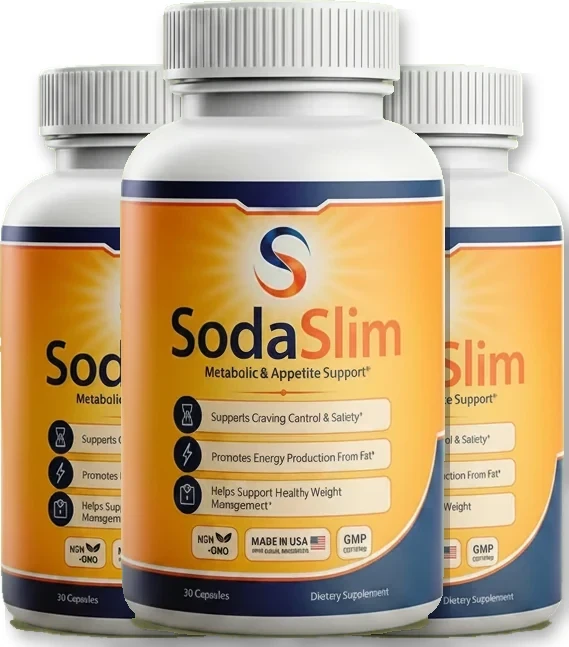
SodaSlim names green coffee bean extract second, with no amount
The ingredients page prints what every trial used, including this one. Sixty days from purchase to decide.
$158 for two bottles, $294 for six, and 60 days from the date you buy
Order SodaSlim On The Official WebsiteLot SOD-26/SO-5737 · 30 capsules · taken once each morning
The blood-pressure literature, which is separate
Chlorogenic acid has a second literature that has nothing to do with weight and is worth knowing about if you are taking a stimulant alongside it.
A meta-analysis of randomised trials found reductions of about 4.3 mmHg systolic and 3.7 mmHg diastolic in favour of chlorogenic acid, calling the size of the effect moderate. Its own limitations section notes that few trials have been conducted, that they are confined to Asian populations, and that they are funded by chlorogenic acid manufacturers. A 2017 review in Nutrition Reviews assesses the same claim in more detail.
That is interesting in a capsule that also contains caffeine, which raises blood pressure acutely. Two ingredients pulling in opposite directions at unknown amounts produce a net effect nobody can calculate, which is a reason for anyone with high blood pressure to stay away from this kind of formula rather than a reason to be reassured by it.
The amounts to look for on a panel
If you are comparing two bottles, this is the arithmetic that separates them.
- An extract weight is not a chlorogenic acid weight. Look for a percentage: 400 mg of extract standardised to 50 per cent chlorogenic acids is 200 mg of the studied compound.
- The trials that read well used 500 to 800 mg a day of extract. A capsule contributing 50 mg is not delivering anything comparable.
- Check whether it is decaffeinated. The 2018 trial used decaffeinated green coffee extract specifically. A caffeinated one is adding to the stimulant total as well.
- Check the trial length against the pack size. Eight to twelve weeks means two to three bottles at one a day, which is a purchasing decision rather than a dosing one.
On the bottle this desk sells, none of those four checks can be completed, because the label artwork carries no Supplement Facts panel. That is stated on every page of this website that touches the subject, and it is the honest answer to the question this section asks.
How to read any ingredient with a retracted flagship
- Find out which paper the claim actually rests on. Usually it is one study and usually it is named.
- Check its PubMed record for a retraction notice. The record says so at the top, in capitals.
- Look for what came after. A retraction does not erase an ingredient; it removes one result, and later work may be better.
- Read the meta-analysis's own limitations paragraph rather than its headline number. In this literature that paragraph is usually the informative part.
- Check who funded the positive trials. Several of the chlorogenic acid results say so in the paper.
One thing the extract label never tells you
Green coffee is coffee. Unroasted beans contain caffeine, and unless an extract has been deliberately decaffeinated it brings some of that caffeine with it.
This matters on a label that already names caffeine anhydrous separately, because the two are additive and only one of them is visible as caffeine to a reader scanning the front of a bottle. A formula naming caffeine anhydrous, green coffee bean extract and green tea extract has three potential sources of the same stimulant, and a single caffeine figure, if one were printed, might cover only the first of them.
Good labels handle this in one of two ways: they state that the green coffee is decaffeinated, or they print a total caffeine line covering every source in the formula. The 2018 metabolic syndrome trial used decaffeinated green coffee extract specifically, which is worth knowing whenever its blood pressure result is quoted on a caffeinated product.
The SodaSlim label says neither. It names green coffee bean extract, prints no amount, and does not say whether it has been decaffeinated, which means the conservative reading of this capsule's stimulant content has to be more conservative than the caffeine row alone would suggest.
The verdict
Green coffee bean extract is not a fraud and it is not a breakthrough. It is an ingredient with a small, mixed evidence base, a famous result that was withdrawn, two more recent trials at 500 to 800 mg a day that reported metabolic changes over eight to twelve weeks, and a separate blood-pressure literature that its own authors describe as narrow and manufacturer-funded.
On a label that prints an amount, it is worth comparing against those figures. On a label that does not, it is one more name you are taking on trust, and the honest thing for a retailer to say is that you cannot check it.
Sources
- Vinson JA, Burnham BR, Nagendran MV. Randomized, double-blind, placebo-controlled, linear dose, crossover study to evaluate the efficacy and safety of a green coffee bean extract in overweight subjects. Diabetes Metab Syndr Obes. 2012;5:21-7. RETRACTED; retraction notice Diabetes Metab Syndr Obes. 2014;7:467. PMID 22291473. https://pubmed.ncbi.nlm.nih.gov/22291473/
- Onakpoya I, Terry R, Ernst E. The use of green coffee extract as a weight loss supplement: a systematic review and meta-analysis of randomised clinical trials. Gastroenterol Res Pract. 2011;2011:382852. PMID 20871849. https://pubmed.ncbi.nlm.nih.gov/20871849/
- Roshan H, Nikpayam O, Sedaghat M, Sohrab G. Effects of green coffee extract supplementation on anthropometric indices, glycaemic control, blood pressure, lipid profile, insulin resistance and appetite in patients with the metabolic syndrome: a randomised clinical trial. Br J Nutr. 2018;119(3):250-258. PMID 29307310. https://pubmed.ncbi.nlm.nih.gov/29307310/
- Sudeep HV, Shyam Prasad K. Supplementation of green coffee bean extract in healthy overweight subjects increases lean mass/fat mass ratio: a randomized, double-blind clinical study. SAGE Open Med. 2021;9:20503121211002590. PMID 33796302. https://pubmed.ncbi.nlm.nih.gov/33796302/
- Pourmasoumi M, Hadi A, Marx W, Najafgholizadeh A, Kaur S, Sahebkar A. The effect of green coffee bean extract on cardiovascular risk factors: a systematic review and meta-analysis. Adv Exp Med Biol. 2021;1328:323-345. PMID 34981487. https://pubmed.ncbi.nlm.nih.gov/34981487/
- Onakpoya IJ, Spencer EA, Thompson MJ, Heneghan CJ. The effect of chlorogenic acid on blood pressure: a systematic review and meta-analysis of randomized clinical trials. J Hum Hypertens. 2015;29(2):77-81. PMID 24943289. https://pubmed.ncbi.nlm.nih.gov/24943289/
- Loader TB, Taylor CG, Zahradka P. Chlorogenic acid from coffee beans: evaluating the evidence for a blood pressure-regulating health claim. Nutr Rev. 2017;75(2):114-133. PMID 28130503. https://pubmed.ncbi.nlm.nih.gov/28130503/